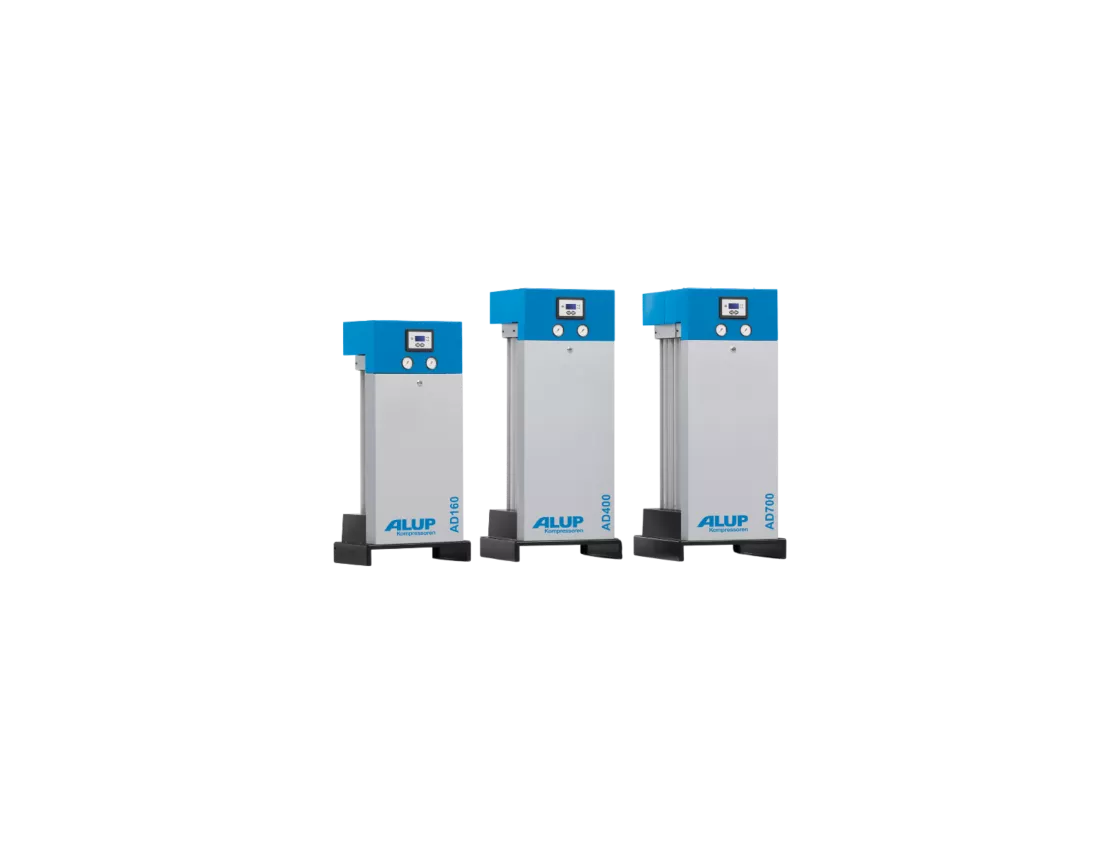
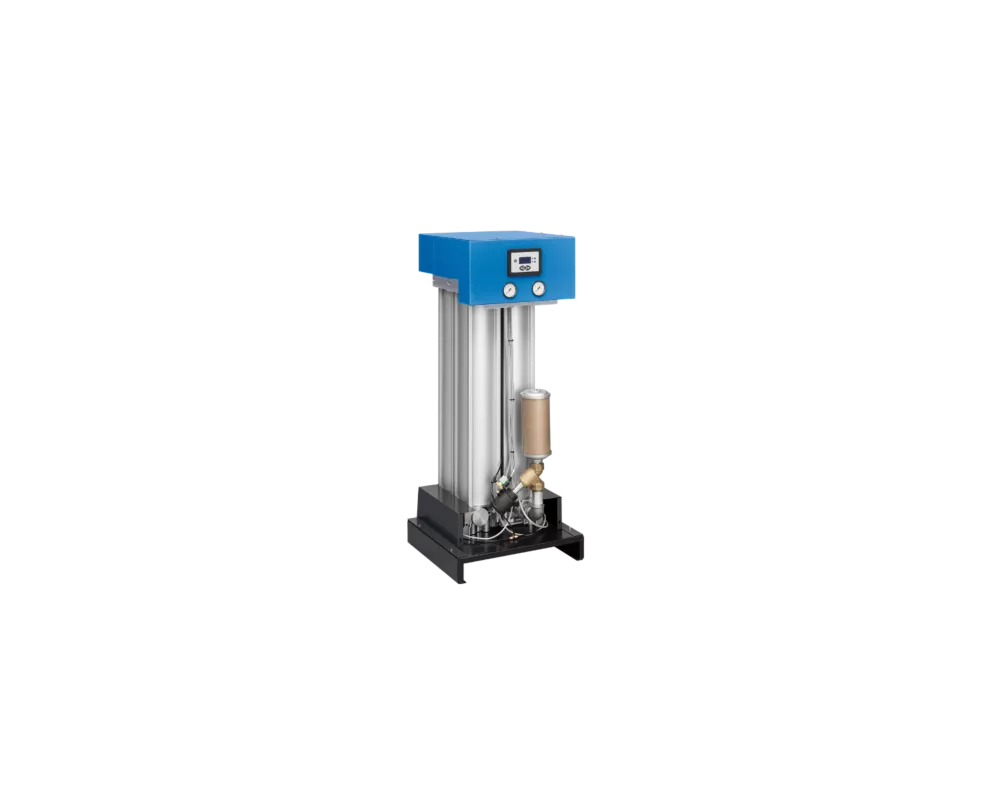
Dry compressed air for processes where moisture can cause problems. The AD series lowers the pressure dew point to -70 °C and helps protect the pipework, the equipment and the production process.
Moisture is removed before it reaches your process
The two chambers work alternately. One chamber dries the compressed air while the desiccant material in the other is regenerated.
Protection for the equipment and for production
Moisture in compressed air can cause corrosion and damage to equipment. The AD dryer removes the moisture and delivers consistently dry air. The material that binds the moisture is usually activated alumina, silica gel or a mixture of the two.
Pressure dew point down to -70 °C
Timer or sensor control
Automatic adjustment of the cycle
For small systems and large industrial plants
How desiccant drying works
Chamber 1It captures the moisture from the compressed air
⇆
Chamber 2The desiccant material is regenerated and prepared for the next cycle
The chambers swap roles automatically to keep the air drying continuously.
01Entry into the active chamber
The compressed air passes through the chamber holding the desiccant material, which captures the moisture.
02Dry air to the network
At the outlet you get air with a very low dew point, which stays stable even when the flow changes.
03Regeneration
Regeneration uses 3-15% of the air already dried, which is passed into the second chamber at atmospheric pressure and carries the moisture out.
04The roles swap
At the end of the cycle the chambers swap roles. One chamber dries the air while the other regenerates, so the process continues without interruption.
!
A pre-filter is mandatory. Oil and water damage the desiccant material and reduce the efficiency of the dryer. A filter separating oil and water must be fitted ahead of every desiccant dryer. This applies to every version, without exception.
Key benefits
The dryness you need with lower air consumption
The models with sensor control monitor the dew point and adjust the cycle to the measured values.
-70
Air quality
A very low dew point
For processes where moisture must be kept to a minimum.
◉
Smart control
A cycle matched to actual demand
The timer version uses the same amount of air for regeneration regardless of the conditions at the time. The sensor monitors the dew point and adjusts the cycle, which reduces unnecessary air consumption.
▦
Maintenance
A durable, practical construction
The solid frame, easy access and long service intervals make maintenance easier.
Choosing the technology
When to choose a desiccant dryer and when a refrigerated one
A refrigerated dryer is enough for most industrial applications. A desiccant dryer is needed when the process requires air with a dew point below 0 °C.
Desiccant dryer
When an exceptionally low dew point is needed
You need a dew point down to -40 °C, and for certain processes down to -70 °C
The pipework runs through unheated rooms or outdoors, where there is a risk of freezing
The air comes into contact with a product, packaging or raw material
Moisture could spoil the paint finish or disturb pneumatic measuring instruments
Refrigerated dryer
For standard industrial applications
A dew point of around +3 °C is enough for your process
The whole installation is in a heated space with no risk of freezing
The air is used for air tools, cylinders and general pneumatics
You are looking for a lower purchase price and lower running costs
Equipment and versions
Easier installation and reliable everyday operation
The design allows integration into different compressed air systems and simple operation.
◫
Multiple connections
Flexible connection to your existing installation.
◌
Efficient silencers
Less noise in operation and during regeneration.
▤
Electronic control
Cycle management, status display and diagnostics.
⌁
Galvanised pipework
A durable build for long term industrial use.
▣
Integrated filters
On AD 7-60 the outlet filters are built into the cartridges.
↥
Forklift slots
Easier moving and positioning of the dryer.
Versions and accessories available
The configuration is determined by the process, the flow rate needed and the air quality required.
Sensor control instead of timer control
A version for a dew point down to -70 °C
A wall mounting kit for the smaller models
The oil and water pre-filter is a mandatory part of the installation
Technical data
Six models with a capacity from 7 to 936 m³/h
Filter the models by series or search for a specific model. The values are taken from the official ALUP site.
Model
Max. pressure
Capacity
Weight
AD 7
16 bar
7 m³/h
13 kg
AD 25
16 bar
26 m³/h
20 kg
AD 60
16 bar
59 m³/h
31 kg
AD 90
14 bar
90 m³/h
87 kg
AD 400
14 bar
396 m³/h
197 kg
AD 940
14 bar
936 m³/h
328 kg
Capacity, pressure and weight depend on the model. The final choice is made according to the flow rate needed, the working pressure and the dew point. On the AD 7-60 models the outlet filter is built in. On the larger models it is ordered separately.
Where it is used
Industries where dry air is essential
Anywhere moisture could spoil the product, cause corrosion or freeze inside the pipework.
🍞Food industry
💉Pharmaceuticals and laboratories
🎨Paint finishing lines
🔌Electronics
❄Outdoor pipework
🔧Pneumatic instrumentation
Practical installation
Compact equipment that fits more easily into the system
Several connection options, the solid frame and the forklift slots make positioning easier. A wall mounting option is also available for certain models.
Quick connectionSeveral inlet and outlet positions
Easier to moveA frame with forklift slots
Less space requiredA compact vertical construction
Choosing by processTimer or sensor control
Do you need a dew point down to -70 °C?
Tell us the flow rate you need, the working pressure you run at and the level of dryness your process requires. We will suggest a suitable AD model and the filtration needed at the dryer inlet.